Complex systems · 2025
Decentralizing Navigation
How do ants find their way home? Replacing a hard-coded "GPS" in a foraging simulation with a pheromone the ants lay themselves.
TL;DR
- In the standard ant foraging simulation, an ant with food “magically” knows the coordinates of its nest.
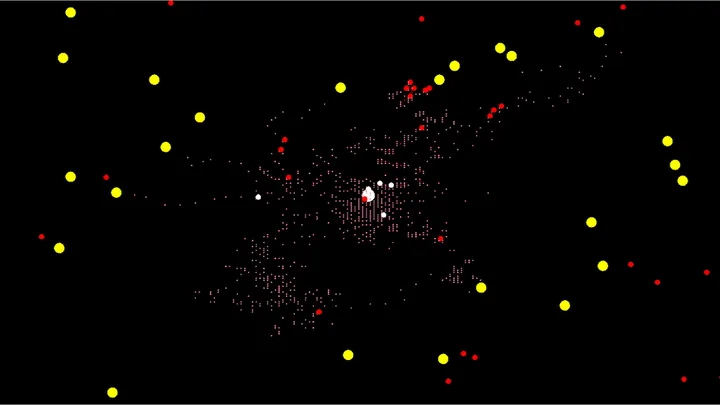
- We replaced that with a third pheromone, the colony pheromone, laid while exploring and followed back uphill.
- Homing emerged from local rules alone — and so did ant mills, the circular traps that real ants fall into too.
- Short-term memory and a little randomness made the system stable.
The problem
Foraging simulations usually model two pheromones: one marking the way to food, one marking explored areas. But the journey home is hard-coded: the ant subtracts its position from the nest’s and walks in that direction. Real ants have no global coordinates. We wanted homing to emerge from what an ant can actually sense.
Biology offered several candidates — visual landmarks, the smell of the area around the nest, home-range marking — and we chose the most common one in ants: following a trail laid during exploration.
The colony pheromone
- Emission. Each ant leaves the nest with a stock of 50,000 units of colony pheromone and deposits it as it explores, losing 10 units per step. The trail is therefore stronger the closer it is to the nest.
- Following. Once an ant finds food, it repeatedly moves to the neighbouring cell with the highest colony pheromone, climbing the gradient back home while laying the food trail for the others.
- Evaporation. A fixed percentage evaporates at every step, so old trails fade and relative concentrations stay meaningful.
We also switched the simulation from moving one ant per step to moving all ants simultaneously, which is closer to reality and makes each time step easier to analyse.
What went wrong, and how we fixed it
| Problem | Cause | Fix |
|---|---|---|
| Pheromone piled up near the nest forever | linear evaporation is slower than deposition in busy areas | exponential evaporation: the more pheromone, the faster it fades |
| Faint residues everywhere | exponential decay never reaches zero | a threshold that snaps values below 1 to zero |
| Ants vibrating between two cells | “always climb” gets stuck in local maxima | a taboo list of the last 6 positions |
| Groups of ants walking in circles | a loop reinforces itself the more it is walked | a 5% chance of a random move, plus tuning of deposit and evaporation |
The circles were the most interesting finding. Ant mills are a documented phenomenon: army ants can follow each other in a circle until exhaustion. Pure gradient ascent with a self-reinforcing signal is inherently fragile, and our simulation reproduced it. Rather than forbid it with artificial rules, we tuned the parameters until milling became rare.
What I took away
- The intelligence is in the environment. The colony pheromone works as an external, shared map: no single ant knows where home is, but the colony does.
- Positive feedback needs noise. Memory and a small amount of randomness were what kept local rules from locking the system into loops.
- Decentralisation has a range. Because the signal evaporates, an ant that wanders too far finds its trail gone. Exploration must expand slowly, at the pace the pheromone network can sustain.
Next steps we discussed: combining several homing mechanisms, as real ants seem to do, and adding competing colonies whose trails cross.